Are Group Fitness Classes Actually Worth Forcing Yourself Into as an Introvert?
Quick Answer: Group classes are worth it for introverts specifically when the format allows low social interaction during the workout itself (like a silent-focus format or a class where instruction, not chat, dominates) — they’re less worth forcing when the appeal is purely social pressure as motivation, since that pressure often produces short-term attendance and longer-term avoidance.
The question isn’t whether group classes work. It’s whether they work for the way you’re actually wired to recover energy.

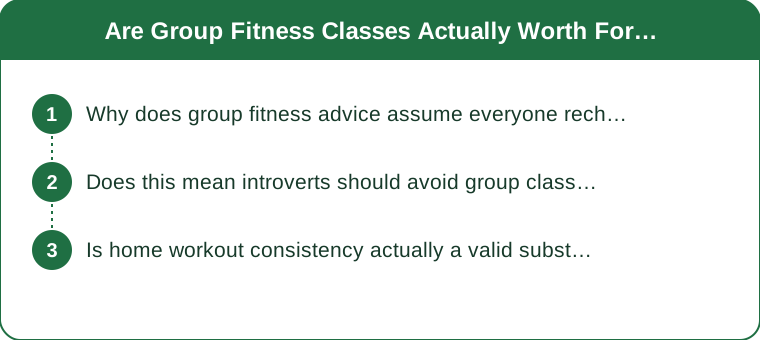
Why does group fitness advice assume everyone recharges the same way?
Most mainstream fitness motivation content is built around extroverted assumptions — that social accountability and group energy are inherently motivating. For introverts, who typically recharge through solitude rather than social interaction, a demanding social environment layered on top of physical exertion can be net energy-draining rather than energy-building, even when the workout itself is enjoyable.

Does this mean introverts should avoid group classes entirely?
Not necessarily — the format matters more than the group setting itself. Classes with minimal required interaction (many yoga, pilates, or cycling formats where you follow an instructor with little peer engagement) can offer structure and motivation without the draining social component. The problem tends to show up specifically in classes built around partner work, constant verbal encouragement between participants, or a strong social-club atmosphere as the main draw.
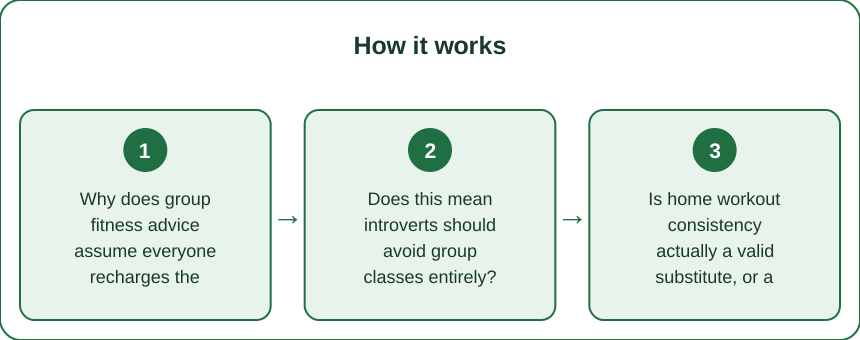
Is home workout consistency actually a valid substitute, or a cop-out?
Research on exercise adherence doesn’t show that group settings are inherently superior for long-term consistency — what predicts adherence best is whether the format matches the person’s actual preferences and energy patterns. For many introverts, a well-structured solo or minimal-interaction routine produces better long-term consistency than a group class they attend out of guilt and eventually abandon.
TL;DR:
- Group classes work best for introverts when the format minimizes required social interaction
- Social-pressure-as-motivation often backfires into avoidance over time
- Solo and low-interaction formats aren’t a lesser substitute — they’re a legitimately different fit
- The question worth asking isn’t ‘will this motivate me short-term’ but ‘will this still feel sustainable in three months’
The honest answer is it depends entirely on which specific class, not on group fitness as a category — worth testing one low-interaction format before writing off the whole category.
Keep Reading
This article is for general informational and styling purposes only. Fit, sizing, and product availability may vary.