Introvert Questions About Phones, Mirrors and Being Filmed at the Gym
Quick Answer: Most gyms have a filming policy and most people do not know it. You are allowed to ask someone to reframe or move, you are allowed to ask staff to handle it instead, and you are allowed to simply move to a different part of the room. The most effective option for most introverts is the quiet one — change your position first, escalate only if it keeps happening.
This is general information, not legal advice.

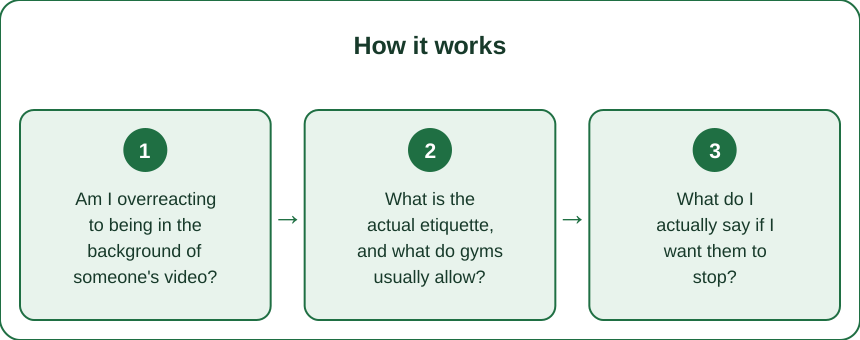
Am I overreacting to being in the background of someone’s video?
No, and the discomfort is not irrational. Being recorded changes behaviour measurably in almost everyone, and the gym is already a space where people feel observed. Adding an actual camera to an environment that already triggers self-consciousness is a real thing, not a sensitivity problem.
It affects introverts disproportionately for a specific reason. The drain is not about the recording itself — it is about the loss of control over how much social exposure you have signed up for. You chose a workout; you did not choose to be content.
Does it matter that they are probably not filming me?
Not really, and that is the part people get wrong when they reassure you. The effect comes from being inside a frame you did not consent to, regardless of who is the subject. Intent does not change how it feels.
Is this more common than it used to be?
Yes, considerably. Phone tripods, form-check videos and fitness content have all normalised recording in shared spaces, and gym policies have generally not caught up with the behaviour.
What is the actual etiquette, and what do gyms usually allow?
Most gyms permit filming yourself and prohibit filming others, which is a distinction that sounds clear and gets blurry in a room with mirrors.
Check your gym’s policy once, in writing. It is usually in the membership terms or on a sign nobody reads. Knowing what it says makes any future conversation far shorter and far less charged.
Changing rooms are almost universally off limits, and this is worth knowing plainly because it is the one situation where you should go straight to staff rather than handling it yourself.
The widely accepted norms among people who film are simple: film yourself, keep the frame tight, do not block equipment or walkways with a tripod, take it down between sets, and reframe if someone asks.
What if there is no policy at all?
Then the reasonable default still applies — you can ask, and staff can make a judgement call. The absence of a written rule does not mean anything goes.
Is it different in a small studio versus a large gym?
Smaller spaces make it much harder to avoid being in frame, and studios more often ban filming entirely for exactly that reason.
What do I actually say if I want them to stop?
Start with the least confrontational version that works, because it almost always does. Most people filming genuinely have not considered that they are capturing anyone else.
The line that works: hey, would you mind angling that away from me? Thanks. Short, friendly, no explanation offered. Explanations invite negotiation; a simple request does not.
Deliver it and then turn back to what you were doing. Standing waiting for a response makes it a conversation. Asking and returning to your set makes it a request that has been made.
You do not owe a reason. The most common mistake introverts make here is over-explaining, which turns a ten-second exchange into a two-minute one and costs far more social energy than the original problem.
What if they react badly?
Stop engaging and go to staff. That is what staff are for, and a bad reaction to a polite request is exactly the situation the policy exists to handle.
Can I ask staff instead of asking directly?
Yes, always, and it is a completely legitimate first choice rather than a fallback. You are not required to handle it yourself to have handled it properly.

What if I would rather not say anything at all?
Then move, and treat that as a real solution rather than a retreat. Changing your position takes eight seconds and costs nothing, and for a one-off it is genuinely the most efficient answer available.
Learn which parts of your gym are filmed most. It is highly predictable — the squat racks with the best mirror, the cable area, the free weights corner with good lighting. Knowing the map lets you plan around it without thinking about it.
Adjust your timing rather than your gym. Filming clusters at peak hours and at the times content creators train. Shifting your session by even an hour changes the room substantially.
Put your back to the mirror where you can. Most of the time you end up in someone’s frame is via a reflection rather than directly.
Does avoiding it just make the anxiety worse?
Not in this case. Avoiding the gym entirely would; choosing a different rack would not. There is a meaningful difference between avoiding a fear and simply declining an unnecessary irritation.
Should I train at home instead?
Only if you would want to anyway. Letting other people’s phones decide where you train hands over more control than the original problem took.
What Nobody Tells You About Feeling Watched at the Gym
The people filming are frequently more self-conscious than you are. Setting up a tripod in a public gym takes a specific kind of nerve, and most of them are intensely focused on their own frame and their own set. You are not the subject of anyone’s attention, which is both reassuring and beside the point.
Mirrors do most of the actual capturing. People underestimate this constantly. A phone pointed at a wall of mirrors captures a much wider slice of the room than the person holding it realises, which is why the polite request often genuinely surprises them.
Your discomfort is about control, not vanity. Naming it accurately makes it much easier to handle, because the solution to a control problem is to take an action — move, ask, or change your timing — and the solution to a vanity problem would be to feel differently, which nobody can do on command.
Asking gets easier extremely quickly. The first time costs a lot; the third time costs almost nothing. This is one of the few social skills where the practice effect is immediate and large.
Staff would generally rather you told them. Members who quietly stop coming are a much bigger problem for a gym than a thirty-second conversation with someone about a tripod, and most staff are aware of that.
And the thing that helps most is unrelated to filming. Having a written plan for your session means you spend far less time standing around looking at the room, and time standing around looking at the room is when almost all gym self-consciousness happens.
One more: headphones and a hood are a legitimate boundary, not an antisocial statement. They visibly signal that you are not available for interaction, and they reduce the low-level social load of the whole session considerably.
FAQ: Filming and Privacy Questions, Answered
Can I ask someone to delete a video I am in?
You can ask, and they may agree. Whether you can require it depends on where you live and the specific circumstances, which is worth raising with gym staff rather than resolving on the gym floor.
What if it is posted publicly and I recognise myself?
Contact the gym first — most policies cover this — and the platform second. Both routes are usually faster than approaching the person directly.
Is it different if a personal trainer is filming their client?
The same norms apply. A trainer working professionally in a shared space is expected to manage their frame, and staff will generally take that request seriously.
How do I stop caring about it?
You probably do not need to. Having a plan for what you will do makes the situation manageable, and manageable is a better target than indifferent.
TL;DR:
- Your discomfort is about consent and control, not vanity — that framing points to actions that work.
- Check your gym’s filming policy once; most permit self-filming and prohibit filming others.
- The effective ask is short and unexplained: would you mind angling that away from me?
- Going to staff is a legitimate first choice, not a fallback.
- Moving racks, changing your timing and putting your back to the mirror solve most of it silently.
You can be quiet about it and still not put up with it.
Keep Reading
This article is for general informational and styling purposes only. Fit, sizing, and product availability may vary.