Introvert Questions About Training Outdoors When the Parks Get Busy
Quick Answer: Crowded outdoor spaces drain introverts for a specific reason - unstructured proximity with unpredictable interaction demands more monitoring than a gym does, where the social rules are known. The fixes are timing, route design, and clear non-verbal signals. Train in the first ninety minutes after sunrise, choose out-and-back routes over loops, and accept that some sessions belong indoors during peak weeks.
The park was empty in June and it is not empty now.
And the odd part is that a busy trail can feel more draining than a busy gym, even though nobody has spoken to you.
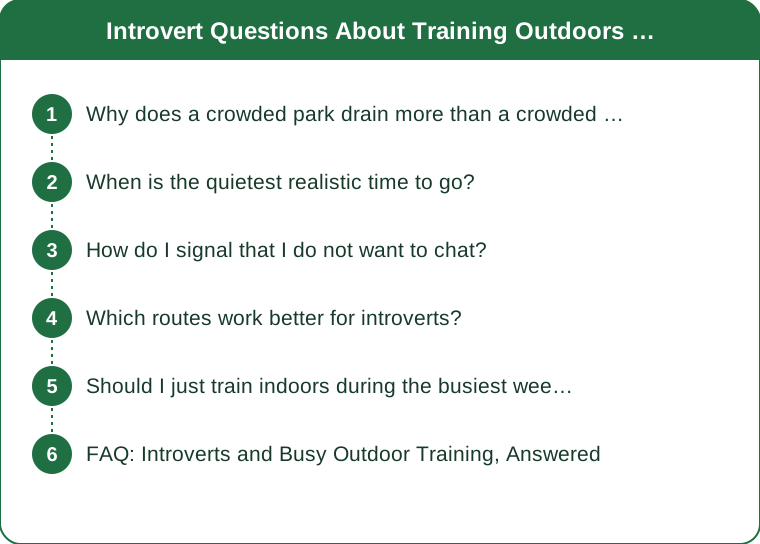
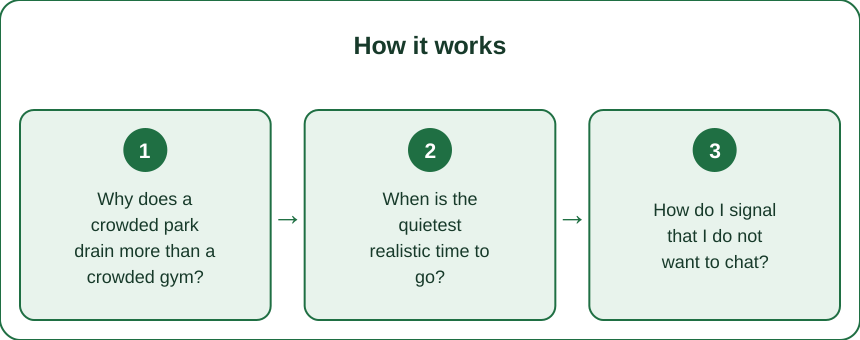
Why does a crowded park drain more than a crowded gym?
Because the social rules are undefined. In a gym, everyone knows the script - headphones mean leave me alone, nobody talks during a set, and eye contact is brief and functional.
Outdoors, none of that is settled. Some people greet everyone on a trail, some nobody, and you cannot tell which you are approaching until you are three metres away.
That uncertainty is the cost. Your brain runs low-level monitoring on every approaching person, deciding whether a greeting is expected, and that monitoring happens perhaps two hundred times on a busy loop.
Gym crowding is dense but predictable; park crowding is sparse but unpredictable, and for most introverts unpredictability is far more expensive than density.
It also explains why an empty trail can be genuinely restorative while a busy one is not, even at the same effort. The difference is not the exercise, it is the number of unresolved social decisions.
Knowing this reframes the problem usefully. You are not antisocial for finding it tiring - you are running a background process that other people are not.
When is the quietest realistic time to go?
The first ninety minutes after sunrise is the most reliably quiet window in almost every park, and it is a bigger effect than any other variable including day of week.
Mid-morning to early afternoon on weekdays is the second-best window in most places. The genuinely worst windows are 5 to 7pm on weekdays and 9 to 11am at weekends.
Late August specifically has a shifting pattern because school schedules are changing week to week. The 8am window that was busy in July is often quiet again once term starts, and after-school hours become the new crowd.
Weather is underrated as a filter. Light rain, wind, or a grey sky reduces park traffic dramatically and changes nothing about your session, which makes the least appealing forecast the most appealing training slot.
As sunrise moves later over the next month, the early window will start requiring a headtorch or better-lit routes. Worth planning now rather than discovering it in October.
One honest caveat: if the quiet window requires a wake time you cannot sustain, it is not a solution. A consistently doable 7am beats an aspirational 5:30am that lasts nine days.
How do I signal that I do not want to chat?
Headphones remain the clearest and most widely understood signal, and they work whether or not anything is playing. Wearing them purely as a boundary marker is entirely legitimate.
Sunglasses do a surprising amount of work by removing eye contact from the equation, which is what most casual greetings are initiated by.
A brief nod is more effective than avoidance. Actively looking away often reads as an invitation to check whether you are alright, whereas a two-second nod closes the interaction cleanly and requires nothing further from either person.
Keep moving. The vast majority of unwanted conversations start when someone is stationary - stretching at a bench, adjusting a shoe, refilling water. Doing those things facing away from the path solves it.
If someone does start a conversation you do not want, a warm short answer plus resuming your pace is enough. You do not owe anyone the negotiation, and most people read the cue immediately.
None of these are rude. They are the outdoor version of the gym script that everyone already accepts indoors - the only difference is that outdoors you have to supply the script yourself.
Which routes work better for introverts?
Out-and-back beats loops. On a loop you meet a continuously refreshing set of people; on an out-and-back you see roughly the same faces twice, which turns unknown approaches into recognised ones and reduces the monitoring load considerably.
Choose the direction most people are not going. On any popular loop there is a dominant direction, and running or walking against it means brief passes rather than sustained proximity - or with it, if you prefer not to be face-on.
Perimeter paths and connector trails are consistently quieter than the main artery. Most park traffic concentrates on one or two central routes, and the outer edges are frequently near-empty at the same hour.
Interval formats change your experience of a crowded space because they give you an internal structure that fills the attention that would otherwise go to monitoring. A timed session feels less socially exposed than an unstructured wander.
Have two routes, not one. Arriving to find your route unexpectedly packed is the scenario that ends sessions, and having a decided alternative removes the decision from a moment when you least want to make one.
Scout on a rest day. Walking a possible route without the pressure of a session tells you more about its rhythm than three attempted workouts will.
Should I just train indoors during the busiest weeks?
Sometimes, yes, and that is a strategy rather than a retreat. The goal is completed training, not proof that you can tolerate a crowded park.
A useful test: if the anticipation of the crowd is affecting whether you go at all, move the session indoors for that period. A home session you actually do beats an outdoor session you skip twice a week.
Late August into September is genuinely a peak crowding window as schools return and everyone restarts routines. It is a temporary spike, not a permanent condition, and treating it as a four-week phase is more accurate than treating it as a decision.
Keep one outdoor session a week if you can, even a short one at the quietest hour. Outdoor light exposure has real effects on sleep and mood, and losing it entirely for a month costs more than the social fatigue does.
Watch for the avoidance spiral, which is the one genuine risk here. Skipping crowds is fine; skipping training is not, and the two blur if you never replace the missed session with anything.
Plan the swap in advance rather than at the moment of decision, because deciding while standing at the edge of a busy park almost always ends in going home.
FAQ: Introverts and Busy Outdoor Training, Answered
Is it normal to find a busy trail more tiring than a busy gym?
Yes, and it is about predictability rather than numbers. Gym social rules are defined and outdoor ones are not, so a sparse but unpredictable space costs more attention than a dense but scripted one.
Do headphones actually stop people talking to me?
Mostly, yes - they are the most widely recognised do-not-approach signal available and they work whether or not audio is playing. Sunglasses stack on top by removing the eye contact that initiates most greetings.
What is the quietest time to train outdoors?
The first ninety minutes after sunrise, in almost every park, by a wide margin. Weekday mid-morning is second. Avoid 5 to 7pm weekdays and 9 to 11am weekends.
Should I greet people on trails?
A two-second nod is the lowest-cost option and it closes the interaction more cleanly than looking away does. Avoidance often prompts a follow-up; acknowledgement does not.
Is training indoors during busy weeks a failure?
No. Completed training is the metric. Late August to September is a temporary crowding spike, and moving sessions indoors for four weeks while keeping one outdoor session is a reasonable plan.
How do I stop a conversation I did not want?
A short warm answer and resume your pace. Most people read it immediately, and you are not obliged to negotiate.
What if my only free time is the busiest hour?
Change the route rather than the time - perimeter paths, out-and-back formats, and the non-dominant direction all reduce the load substantially without needing a different hour.
TL;DR:
- Busy parks drain introverts because outdoor social rules are undefined, not because of crowd density - your brain runs a monitoring process on every approach.
- The first ninety minutes after sunrise is the most reliably quiet window, by a wide margin.
- Headphones and sunglasses are legitimate boundary signals; a two-second nod closes interactions better than avoidance.
- Out-and-back routes, perimeter paths, and the non-dominant direction all cut the monitoring load.
- Moving sessions indoors during the four-week back-to-school spike is a strategy, as long as you keep one outdoor session and actually do the replacement.
Completed training is the metric, not proof that you can tolerate a crowded loop.
Keep Reading
This article is for general informational and styling purposes only. Fit, sizing, and product availability may vary.