Do Introverts Actually Need a Workout Partner? An Honest Q&A
Quick Answer: No. The accountability benefit in the research comes from commitment and tracking, not from physical company — and both are available without a partner. Introverts who force partner workouts often trade a small consistency gain for a large energy cost, and quit sooner as a result. Async accountability — a shared log, a coach checking in weekly, a public streak — captures most of the benefit at a fraction of the drain.
Every fitness article eventually tells you to find a workout buddy. If the thought of that makes you tired before you’ve even started, this is for you.
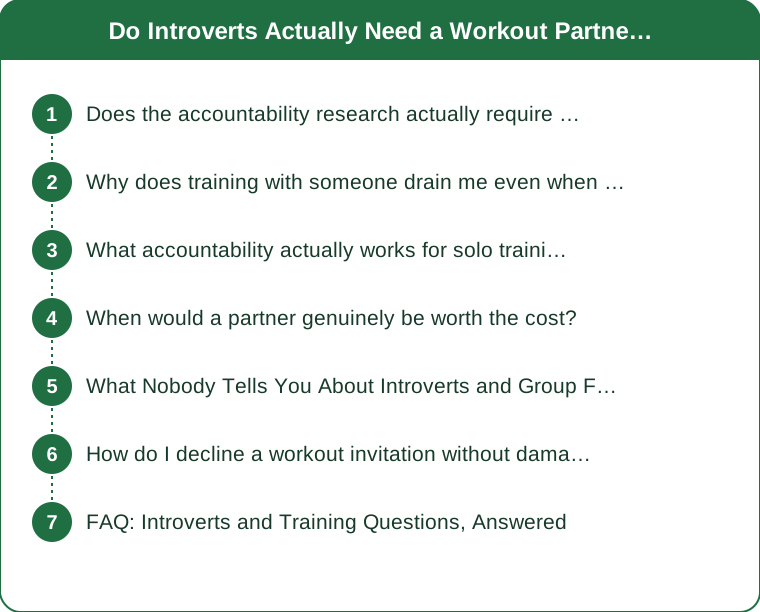
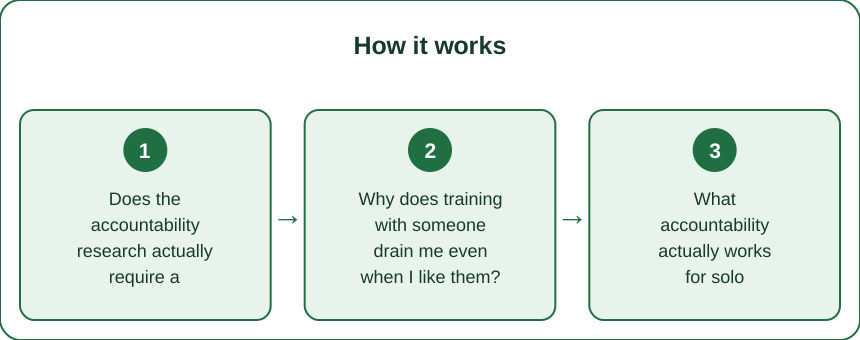
Does the accountability research actually require a partner?
No — it requires a commitment someone can see. That’s a much lower bar.
The well-replicated finding is that people who make a specific, observable commitment follow through more than people who intend privately. Specificity and visibility are doing the work.
A partner is one delivery mechanism for that. It isn’t the only one. A trainer who reviews your log weekly, a shared spreadsheet with a friend, a public streak counter, or a standing paid class booking all supply visibility.
The distinction that matters: synchronous versus asynchronous accountability. Synchronous means you’re both there at the same time. Asynchronous means someone sees the result afterward. The research doesn’t strongly distinguish between them, but your energy budget absolutely does.
If you’ve been told you need a gym buddy and it never stuck, you weren’t failing at accountability. You were using an expensive version of it.
Why does training with someone drain me even when I like them?
Because social presence carries a processing cost that has nothing to do with whether you enjoy the person.
Being observed changes performance and attention. Even in comfortable company, part of your attention is allocated to the other person — reading them, coordinating pace, managing conversation timing. That’s real cognitive load running in parallel with the physical work.
Introversion in the research sense is about arousal and recovery, not shyness. Higher baseline sensitivity to stimulation means social input costs more and takes longer to recover from. You can genuinely enjoy someone and still need an hour alone afterward.
Training is already a stimulation load. Noise, music, mirrors, other people’s movement. Adding a conversation partner on top of that is what pushes a manageable session into a depleting one.
The tell is what happens after. If you’re consistently flat for the rest of the day after partner workouts but fine after solo ones, that’s the cost showing up on the ledger — and it compounds across a week.
What accountability actually works for solo training?
Anything that creates a visible record without requiring live company.
A written log that someone else can see. A shared note with one friend, updated after each session. No conversation required — just the record existing where another person could look. This captures most of the visibility effect.
A paid standing commitment. A class booked and charged whether you attend or not, or a monthly session with a coach who expects a log. The financial and social stakes exist without a live workout partner.
Public streaks. A calendar with X’s, a habit app, a training log. Self-observation is weaker than external observation but it isn’t nothing, particularly for people who are already conscientious.
A weekly asynchronous check-in. One message to a coach or friend on Sunday summarizing the week. Five minutes of social contact instead of five hours.
Scheduled, non-negotiable time blocks. For a lot of introverts, the binding constraint isn’t motivation at all — it’s that unprotected time gets consumed by everything else. A calendar block you treat as fixed does more than any accountability partner would.
When would a partner genuinely be worth the cost?
Three specific situations, and outside them the math usually doesn’t work.
Heavy lifting where you need a spotter. This is a safety requirement, not an accountability one. You need a competent human for near-limit bench press and squat work, and no app substitutes.
Learning a technical skill. Olympic lifts, climbing, martial arts, anything where real-time external feedback accelerates learning substantially. Here the partner is providing information, not motivation — and it’s usually a coach rather than a friend.
A genuine motivational floor. If you’ve honestly tried solo structures for a couple of months and consistency is still near zero, a partner may be the intervention that gets you moving. Something imperfect that happens beats something ideal that doesn’t.
Outside these, run the cost-benefit honestly. If partner workouts cost you two hours of post-session recovery and produce one extra session per week, you’re paying a lot for a small gain — and the exhaustion is what eventually ends the habit.
What Nobody Tells You About Introverts and Group Fitness
Parallel presence is not the same as social interaction, and confusing the two costs introverts a lot of good options.
Being in a room with people while doing your own thing is often fine — a quiet gym floor, a lap pool, a yoga class where nobody talks. What’s draining is interaction: conversation, partner drills, being called on, introductions. Many introverts write off all group settings because of experiences with the interactive kind.
Class format matters far more than class type. The same style of class can be exhausting with an interactive instructor and completely fine with a quiet one. Try the same class with a different instructor before deciding the format doesn’t suit you.
Off-peak hours change the experience entirely. A gym at 6am or 2pm is a different environment from the same gym at 6pm. This is the single highest-leverage adjustment available, and it’s free.
Headphones are a socially accepted boundary. Wearing them signals unavailability without requiring you to say anything, which is exactly the kind of low-cost boundary that makes public gyms tolerable.
The idea that you need to “push through” social discomfort to get fit is unsupported. Adaptation responds to load, frequency, and consistency. It has no opinion about whether anyone else was in the room.
How do I decline a workout invitation without damaging the friendship?
Say yes to the person and no to the format.
“I train better alone, but I’d love to get coffee after” does the whole job — it declines the workout while making clear the relationship isn’t what’s being turned down. The most common mistake is a vague no, which reads as a no to the person.
Offer an asynchronous alternative. “Want to share a training log?” or “Send me your week and I’ll send mine” gives you the accountability benefit and gives them the connection they were after. A lot of people offering to train with you are actually offering friendship, and this satisfies it.
Be direct about the mechanism rather than apologetic. “I get more out of training solo — I lose focus when I’m talking” is honest and unarguable. You don’t owe anyone a justification framed as a flaw.
If it’s a partner or housemate, negotiate parallel rather than joint. Same gym, same time, separate workouts, meet at the end. This works remarkably well and almost nobody proposes it.
FAQ: Introverts and Training Questions, Answered
Will I make less progress training alone?
No. Progress comes from progressive overload, adequate recovery, and consistency. None of the three requires company. The only genuine exception is heavy barbell work where a spotter is a safety requirement.
What about the motivation on days I don’t want to go?
Solo training solves this with structure rather than a person. A fixed schedule, a written plan you don’t have to decide about, and a minimum viable session — ten minutes, then you may stop — handle most low-motivation days better than a partner does, because they cost you nothing on good days.
Is a home gym the right answer for introverts?
Often, though not always. It removes travel, social exposure, and equipment waiting, which is a real advantage. The risk is that home has more competing distractions and no environmental cue that says “now we train.” A dedicated space and a fixed time solves most of that.
How do I know if I’m being introverted or avoidant?
Useful distinction: introversion is a preference that lets you train happily alone. Avoidance keeps you from training at all. If you’re consistently active on your own terms, that’s a preference working as intended. If you’re avoiding the activity itself, the issue isn’t the social format.
TL;DR: You don’t need a workout partner. You need visibility, and those aren’t the same thing.
- The accountability research is about observable commitment, not physical company. Async delivers most of it.
- Social presence has a real energy cost even with people you like — it’s arousal and recovery, not shyness.
- What works solo: a shared log, a paid standing booking, a weekly check-in message, protected calendar blocks.
- A partner is genuinely worth it for spotting heavy lifts, learning technical skills, or when solo has honestly failed for months.
- Parallel presence ≠ interaction. Off-peak hours and a quiet instructor change everything.
- Decline the format, not the person: “I train better alone — coffee after?”
Your muscles have no idea whether anyone was watching.
Keep Reading
This article is for general informational and styling purposes only. Fit, sizing, and product availability may vary.