Do Introverts Need Recovery Time After Race Day?
Quick Answer: Yes, and the mechanism is separate from physical recovery. A race day involves several hours of crowd density, noise, unpredictable social interaction, and sustained low-level vigilance, all of which draw on the same self-regulation resources as any demanding cognitive task. That depletion is real and it resolves on its own timeline, typically 24 to 72 hours, largely independent of how your legs feel. Planning a quiet day after a race is not indulgence, it is scheduling for a cost you actually incurred.
Your legs were fine by Tuesday. You were not.
And the confusing part is that you enjoyed it. Enjoying something and being depleted by it are entirely compatible, which is the piece that makes this hard to name.

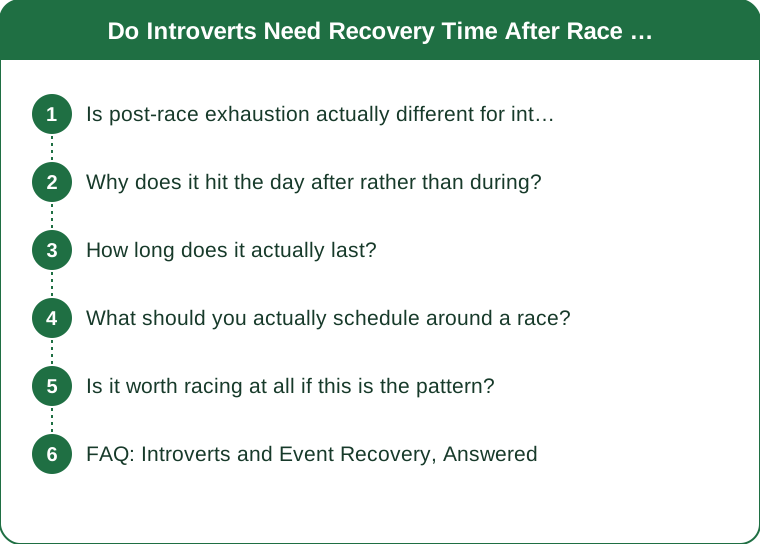
Is post-race exhaustion actually different for introverts?
The physical recovery is the same. The additional cost is not.
Race day is a dense social environment: a packed start corral, hours of proximity to strangers, constant noise, spectators, a finish area designed to be maximally stimulating, and often travel with a group on both ends.
For anyone, that is stimulating. The difference in trait introversion is in the arousal baseline. The dominant model in personality research holds that introverts operate at a higher baseline cortical arousal, so a given level of external stimulation pushes them further past their comfortable range than it does someone with a lower baseline.
The practical result is not that introverts dislike the event. It is that the same event costs them more of a finite regulatory resource.
And there is a second cost specific to racing: managing your own presentation while depleted. Being cheerful at the finish, talking to people while exhausted, and doing group photos when you would like to sit down all require active self-regulation, which is precisely the resource already being drawn down.
Why does it hit the day after rather than during?
Because adrenaline and event focus mask it in real time.
During the race and immediately after, you are running on sympathetic arousal, and social demands are absorbed by the same activated state that is getting you through the physical effort. You feel fine. Often you feel great.
The drop comes when that state resolves, which is typically that evening or the following morning. What you experience then is the accumulated cost arriving all at once, without the arousal that was covering it.
This is also why people misattribute it. By the time you feel flattened, you are at home, the race is over, and the obvious explanation available is physical fatigue. So people conclude they are unfit or that they overtrained, when the physical component is often modest and recovering normally.
A useful separator: physical fatigue is worse with movement and better with rest. Social depletion is largely unaffected by movement and better with solitude. If a gentle walk alone makes you feel noticeably better rather than worse, the fatigue was not primarily physical.
How long does it actually last?
Usually 24 to 72 hours, and it correlates more with the social density of the day than with the race distance.
A 5k with a group trip, a shared meal afterwards, and a crowded expo the day before can cost more social recovery than a solo half marathon in a small local field.
Factors that lengthen it:
- Travel with a group, particularly shared accommodation
- Multi-day events with an expo or pre-race gathering
- Being responsible for organizing others
- Having to be social immediately after finishing
- Poor sleep the night before, which reduces regulatory capacity going in
Factors that shorten it:
- Arriving and leaving alone, even if the race itself is with others
- Any solitary buffer time between the event and the next social demand
- A quiet, uncommitted day after
The most useful thing to know: it is predictable. If you have noticed a two-day pattern after previous races, plan for two days rather than being surprised by it each time.

What should you actually schedule around a race?
Treat the social load as part of the event plan, the same way you plan fueling.
Before:
- Protect the two days prior. Not just for sleep and legs, but for regulatory capacity. Going into a race already socially depleted from a demanding week makes the whole thing more expensive.
- Do the expo early or skip it. Expos are among the most draining parts of a race weekend and among the least necessary.
- Consider travelling separately even when racing with friends. Shared travel doubles the social hours around an event.
During:
- Arrive with a plan for the wait. The pre-race period in the corral is often the most stimulating part of the day. Headphones are entirely acceptable and are what a lot of experienced racers use.
- Give yourself permission to leave the finish area. You do not owe anyone an hour in the festival zone.
After:
- Schedule the following day as genuinely open, not as a day with one small commitment. One small commitment consumes the whole day’s recovery for most people.
- Do the debrief later. The group message thread, the photos, the analysis, all of it can happen in three days. Nothing is lost.
- Move gently and alone. A solo walk does more for this kind of recovery than either complete rest or a group session.
Is it worth racing at all if this is the pattern?
For most people, yes, and the framing that helps is treating it as a cost you budget rather than a flaw you fix.
The question is not whether the day is depleting. It is whether it is worth the depletion, and that is a genuinely personal answer that can be different for different events.
Some adjustments that keep the good part and cut the cost:
- Choose smaller races. A 300-person local event delivers most of what a 30,000-person one does, at a fraction of the social density. Many introverted runners land here permanently and are happier for it.
- Race more often, at lower stakes. Frequent small events normalize the environment and reduce the novelty component of the stimulation.
- Pick your one big race a year rather than several. If large events are what you love, budget the recovery and do fewer of them.
- Volunteer at one instead of racing it. A defined role with a clear script is dramatically less depleting than unstructured social exposure, and a lot of people find they enjoy the day more.
What does not work: trying to become someone who does not find it depleting. Trait introversion is stable, and the energy cost is not a habit you can train away. What you can change is the environment and the schedule around it.
Season note: autumn is peak race season in most places, and the calendar density is the specific risk. Three events in six weeks is very different from three across a year, and the recovery cost does not reset fully between closely spaced events. If your fall calendar has more than one large race in it, look at the gaps now.
This is general information, not medical advice. Fatigue that persists for more than a week after an event, or that comes with other symptoms, is worth having looked at rather than attributed to the crowd.
FAQ: Introverts and Event Recovery, Answered
Why am I exhausted after a race even though the distance was easy?
Because the social and sensory load of race day draws on a separate resource from physical recovery. Crowd density, noise, and unstructured interaction deplete self-regulation capacity regardless of how your legs feel.
How long should I plan for?
Usually 24 to 72 hours, and it correlates more with the social density of the weekend than with the race distance. If you have seen a two-day pattern before, plan for two days.
Does this mean I should not race?
Not at all. It means budgeting the recovery rather than being surprised by it, and choosing event sizes and calendar spacing deliberately. Smaller local races deliver most of the experience at a fraction of the social cost.
TL;DR:
- Race day carries a social and sensory cost that is separate from physical recovery and resolves on its own timeline, typically 24 to 72 hours.
- It hits the day after because adrenaline masks it during the event.
- A gentle solo walk helping more than rest is the clearest sign the fatigue was not primarily physical.
- Protect the two days before, skip or shorten the expo, travel separately, and leave the day after genuinely open.
- Smaller races cost far less socially and deliver most of the same experience.
You did not get unfit and you did not do the race wrong. You spent something the training plan never listed.
Keep Reading
This article is for general informational and styling purposes only. Fit, sizing, and product availability may vary.