Is It Normal to Dread the Gym When You Actually Love Training?
Quick Answer: Yes, and the two feelings are about different things. Loving training is about the physical work. Dreading the gym is usually about the social and sensory environment — being observed, unpredictable interactions, noise, crowding, and the transition cost of entering a stimulating space. Separating them makes the problem solvable, because you can change the environment without changing the training.
The dread is real information about the setting, not evidence that you do not want to train.

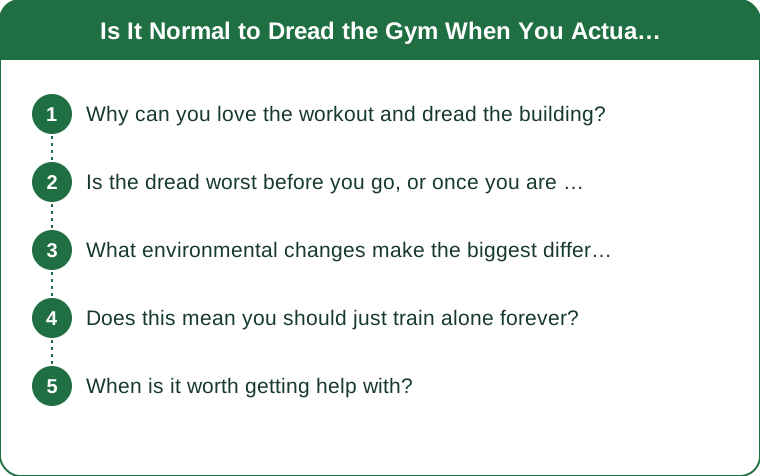
Why can you love the workout and dread the building?
Because they are two entirely different experiences that happen to be bundled together.
The workout is predictable, self-directed and internally focused. You know what you are doing, you control the pace, and your attention is on your own body. For a lot of people, particularly introverts, that is genuinely restorative.
The gym environment is the opposite. It is unpredictable — you do not know who will be there, what will be occupied, or whether someone will talk to you. It is observed, or feels observed. It is loud, bright and crowded at peak hours. And it requires low-level social navigation continuously: who is using this, can I work in, do I acknowledge that person I half-know.
None of that is the training. It is the packaging around the training.
Why introverts feel this more acutely: the differences in how introverts and extroverts respond to stimulation are reasonably well-documented, with introverts generally reaching a comfortable stimulation threshold sooner. A busy gym is a high-stimulation environment, and reaching that threshold does not require anything to go wrong.
The practical implication is the useful part: if the dread is environmental, environmental changes fix it. You do not need to want it more.
Is the dread worst before you go, or once you are there?
Almost always before, and that pattern is diagnostic.
Most people report that the anticipation is considerably worse than the reality. Once you are in, warmed up and into the second exercise, the dread has usually dissolved entirely. That gap between anticipated and actual difficulty is one of the most consistent features of this experience.
Why the anticipation is worse: anticipating a stressful situation involves imagining all the possible versions of it, including the socially awkward ones. Being in the situation involves only the one that is actually happening, which is nearly always more boring than the imagined versions.
What this tells you about where to intervene: the barrier is at the door, not inside. So the interventions that work are the ones that reduce the friction of getting there — packing the bag the night before, going at the same time every day so it is not a decision, having the first exercise already decided.
A useful reframe: commit to going and doing the first exercise only. If you still want to leave after that, you can. Almost nobody leaves. This works because it removes the whole imagined session from the decision and replaces it with one small, concrete action.
When the pattern is reversed — you are fine going and it gets worse as the session goes on — that is a different problem, usually about crowding, feeling watched during specific exercises, or social interactions that happened. That points to timing and layout changes rather than to the doorway.

What environmental changes make the biggest difference?
Five, roughly ordered by impact.
1. Change your time, not your gym. The difference between a gym at 6pm and the same gym at 10am is enormous. Off-peak hours — mid-morning, mid-afternoon, or late evening — transform the experience for most people. This single change resolves the problem for more people than any other intervention.
2. Have a written plan you do not have to think about. Decision-making in a stimulating environment is what drains attention. Walking in with the session already written removes the need to improvise, and improvising is where the self-consciousness lives.
3. Use headphones deliberately. Beyond the music, headphones are a widely recognized social signal that you are not available for conversation. Noise-canceling ones also directly reduce the sensory load, which is doing more than the social signaling.
4. Learn the layout so you have a route. Knowing exactly where you are going and in what order removes the wandering-around-looking-lost phase, which is where a lot of gym self-consciousness concentrates.
5. Pick a corner and own it. Most gyms have a quieter area — a functional training zone, a back corner of the free weights, a stretching area. Training in a consistent spot makes the space feel known.
And the bigger option worth considering: a home setup, a smaller gym, or outdoor training. Not as a retreat, but because the environment is a legitimate variable to optimize. A modest home setup that you use five times a week beats a fully equipped gym you attend twice.
Does this mean you should just train alone forever?
Not necessarily, and the answer depends on what you are actually getting from the environment.
Where the gym environment genuinely gives you something: access to equipment you would not otherwise have, a physical separation between home and training that helps some people focus, accountability from having left the house, and occasionally the ambient energy of other people training, which some introverts do find motivating even without interacting.
Where it gives you nothing: if you have a full home setup, train the same way regardless of setting, and interact with nobody, then the gym is providing a commute and a stimulation cost with no return. That is a reasonable thing to notice.
A middle path a lot of people land on: home or outdoor training for most sessions, gym for the sessions that genuinely need equipment. This is not a compromise, it is optimization.
On group classes specifically: the fact that you dread them does not mean they are bad for you, and it also does not mean you have to do them. Group settings offer coaching, structure and social connection, all of which are real benefits. If the cost of accessing them exceeds the benefit for you, skipping them costs you nothing that you cannot get elsewhere.
The distinction worth drawing: avoiding something because it is genuinely draining and offers you little is a reasonable preference. Avoiding something you would actually enjoy because the anticipation is uncomfortable is worth pushing on gently. Only you can tell which one is happening, and the test is how you feel afterwards, not before.
When is it worth getting help with?
When avoidance is spreading, or when the dread does not follow the usual pattern.
Signs it is ordinary introvert friction: the dread is specific to the gym environment, it is worse before than during, it resolves once you start, and it does not affect other areas of your life.
Signs it is worth talking to someone about: the anxiety is intense rather than uncomfortable, it is generalizing to other public settings, it is causing you to avoid things you genuinely want to do, or it comes with physical symptoms like a racing heart, nausea or panic. Social anxiety is common, treatable, and distinct from introversion — introversion is a preference about stimulation, and anxiety is a fear response. They can look similar from the outside and they respond to different things.
Where a trainer helps: a session or two with a coach who knows you are not looking for a hype presence can be genuinely useful. It builds familiarity with the equipment and the space, and having a plan someone else wrote removes a layer of decision-making. Telling a trainer you prefer minimal conversation is a completely ordinary request.
And the thing worth saying plainly: wanting to train alone, quietly, at an unpopular hour, with headphones on and no conversation, is a completely legitimate way to train. It is not a limitation you should be working to overcome. Plenty of consistent, strong, healthy people have trained exactly that way for decades.
FAQ: Gym Dread Questions, Answered
Does the dread go away with time?
It usually reduces substantially as the environment becomes familiar — familiarity removes most of the unpredictability that drives it. It rarely disappears entirely for people who are genuinely drained by stimulating environments, and that is fine.
Should I force myself to go on days I dread it most?
Use the first-exercise commitment rather than forcing the whole session. If you routinely feel better after going, the dread is not good information about the session. If you routinely feel worse, that is worth listening to.
Is training at home actually as effective?
For most general fitness goals, yes, with a modest equipment investment. For heavy barbell strength work or specific machine-based training, the gym has real advantages. Match the setting to the goal rather than assuming one is superior.
TL;DR:
- Loving training and dreading the gym are about different things: the work versus the environment.
- The dread is almost always worse before than during, which means the barrier is at the door.
- Changing your time to off-peak fixes it for more people than any other single change.
- A written plan, headphones and a consistent spot remove most of the in-session friction.
- Training alone at a quiet hour is a legitimate long-term approach, not a problem to overcome.
- Intense anxiety, physical symptoms or spreading avoidance are worth a conversation with a professional.
The dread is information about the setting, not about the training. Change the setting.
Keep Reading
This article is for general informational and styling purposes only. Fit, sizing, and product availability may vary.