Introvert Questions About Restarting at the Gym After Time Off
Quick Answer: The hardest part of restarting isn’t the training — it’s being conspicuous again in a space where everyone else has a routine. Almost all of it is solvable by choosing your hours deliberately, having your first three sessions planned in advance, and starting well below what you think you can do. Nobody is tracking your absence, and the discomfort fades in about two weeks.
You know how to train. You’ve done this before. And you’ve been standing outside the door for four months anyway.
Here are the questions people actually have, answered without the pep talk.

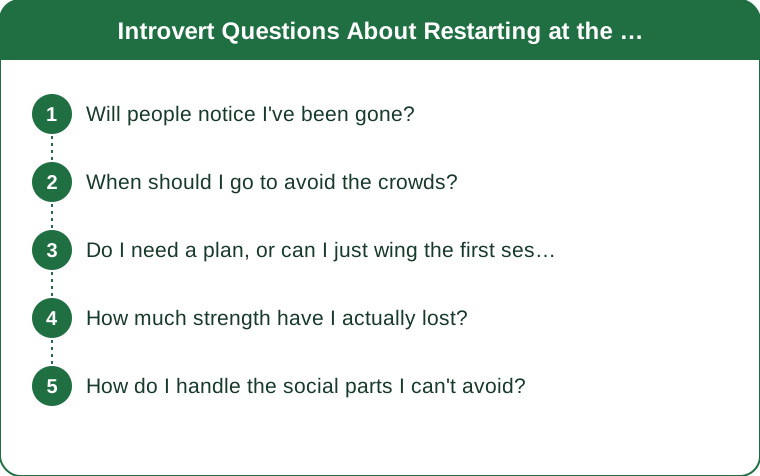
Will people notice I’ve been gone?
Almost certainly not, and this is the single most useful thing to internalize.
Gym populations turn over constantly, most people train with headphones on and attention inward, and the regulars you’re picturing as an established community are largely a group of individuals who don’t know each other’s names either. The mental model of a room full of people tracking attendance simply doesn’t match how gyms work.
If someone does say something, it’s nearly always a friendly haven’t seen you in a while rather than an evaluation. A neutral yeah, been away, good to be back closes it completely, and most people are looking for a two-second exchange rather than a conversation.
The staff may notice, because it’s their job. They also see this constantly and think nothing of it.
When should I go to avoid the crowds?
Mid-morning on weekdays, roughly 10am to noon, is the quietest window in most gyms. Early afternoon, around 1:30 to 3:30, is second.
The hours to avoid while you’re rebuilding confidence: 6-8am, 5-7:30pm, and Saturday mornings until about 11. Those are the peak windows in nearly every commercial gym.
A note specific to this time of year: September is the second-busiest month after January. School returns, summer ends, and gym attendance jumps sharply for about six weeks. If you’re restarting now, expect it to be busier than the same time in July, and weight it toward the off-peak hours accordingly.
If your schedule only allows peak hours, choose your equipment strategy rather than your time. Free weights and machines in the back corners stay accessible when the cardio floor and the squat racks are queued. Plan a session that works with whatever is free rather than one that requires a specific station.

Do I need a plan, or can I just wing the first session?
Have a plan. This matters more for introverts than the generic advice suggests, and for a specific reason.
Wandering the floor deciding what to do next is when you feel most conspicuous — you’re standing still, visibly uncertain, in a room where everyone else appears purposeful. That’s the exact feeling that keeps people from coming back.
Write out three sessions before you go. Not a twelve-week program — three sessions, with exercises, sets, and starting weights. Keep them on your phone. When you finish one movement you go directly to the next, and the deciding-in-public problem disappears entirely.
Include a backup for each exercise in case the equipment is taken. This removes the other stress point: standing next to an occupied rack trying to work out whether to wait, ask, or move on.
What if I forget how to use something?
Look it up on your phone, standing to the side. Everyone with a phone in a gym looks identical, and nobody can tell whether you’re checking form or a message. This is the easiest workaround available and it removes the need to ask anyone anything.
Should I book an induction to relearn the layout?
If the gym is new to you, yes — a scheduled 20-minute walkthrough at a quiet hour is far less draining than working it out under observation over several weeks. If you know the room, skip it.
How much strength have I actually lost?
Less than you fear, and it comes back much faster than it built.
Detraining is real — measurable strength decline typically begins after a few weeks off and continues gradually. But the return is disproportionately fast, largely because the neural component of strength recovers quickly and muscle rebuilds faster than it was originally built.
A practical expectation: after a few months off, most people are back near their previous numbers within four to eight weeks of consistent training.
Start well below what you think you can lift. Around 50-60% of your previous working weights for the first two sessions. This isn’t just caution — the limiting factor in the first weeks back is connective tissue and soreness, not muscle. Going in near your old numbers produces soreness severe enough to cost you the following week, which is how a restart becomes another gap.
Why am I so much more sore than I expected?
Muscle damage from unfamiliar loading peaks 24-48 hours later and is dramatically higher when you’re detrained. It’s normal, it’s not injury, and it diminishes sharply after the first two or three sessions. Starting lighter is what keeps it manageable.
Should I do less than the plan on day one?
Yes. Finish the first session feeling like you could have done more. That’s the correct calibration for week one, and it’s the strongest predictor of whether week two happens.
How do I handle the social parts I can’t avoid?
Three situations come up, and each has a straightforward script.
Someone wants to work in with you. Sure, go ahead — then use their set as your rest. It’s a normal gym convention, it costs you nothing, and declining takes more social energy than agreeing.
A trainer approaches to offer a session. Thanks, I’m good for now is complete and requires nothing further. You don’t owe a reason, and a brief, pleasant no is easier than an explanation.
Someone starts a conversation between sets. Headphones in — even at zero volume — is the widely understood signal for not right now, and it’s respected in essentially every gym. If a conversation does start, a friendly two-sentence exchange followed by turning back to your set ends it without awkwardness.
Is it rude to keep headphones in the whole time?
No. It’s the standard convention in commercial gyms and nobody reads it as unfriendly. It’s the single most effective boundary available in the space.
What if I feel drained afterward even though the workout was fine?
That’s the social load, not the training load, and it’s a real cost. Budget for it — especially in the first weeks back, when the environment is unfamiliar again. Plan the rest of your day lighter, and expect this to fade as the space stops feeling new.
Should I just train at home instead?
It’s a legitimate choice, not a retreat. But if you’re going to the gym for equipment you can’t replicate at home, or because leaving the house is what makes it happen, the discomfort is worth two weeks of pushing through. Give it four sessions before deciding — the unfamiliarity fades faster than the equipment gap closes.
TL;DR:
- Nobody noticed you were gone. Gym populations turn over constantly and attention is inward.
- Train mid-morning or early afternoon; expect September to be unusually busy.
- Write three sessions in advance with backups — deciding on the floor is what makes you feel conspicuous.
- Start at 50-60% of your old weights. Strength returns in four to eight weeks; excessive soreness costs you week two.
- Headphones are a fully accepted boundary, and short scripts handle everything else.
Book the first session for a Tuesday at 10am, write it out tonight, and plan to finish feeling like you had more left. That’s the whole restart.
Keep Reading
This article is for general informational and styling purposes only. Fit, sizing, and product availability may vary.