Do You Actually Need a Workout Buddy? An Introvert's Honest Answer
Quick Answer: No — workout buddies help some people through social accountability, but for many introverts, the social energy cost of coordinating and performing for a partner actually reduces consistency. Structural accountability (tracking, scheduling, streaks) tends to work better than social accountability for this group.
The fitness industry treats workout buddies as universally beneficial, but that advice was built around how extroverts recharge, not how introverts do. Here’s a more honest look at what actually drives consistency when you’re not energized by working out with someone else.

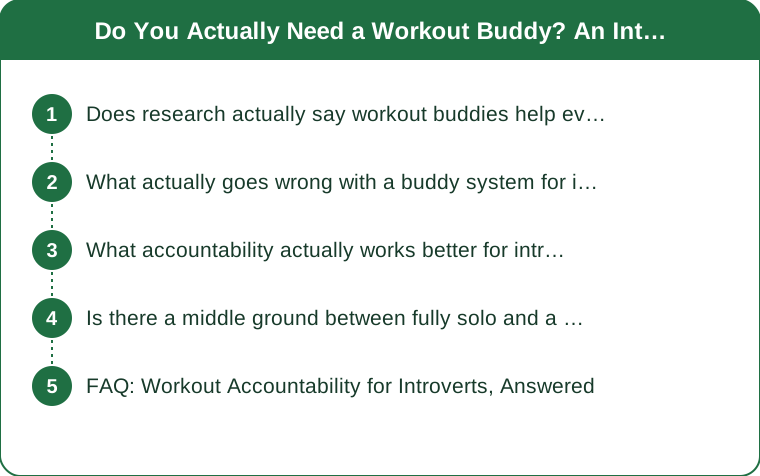
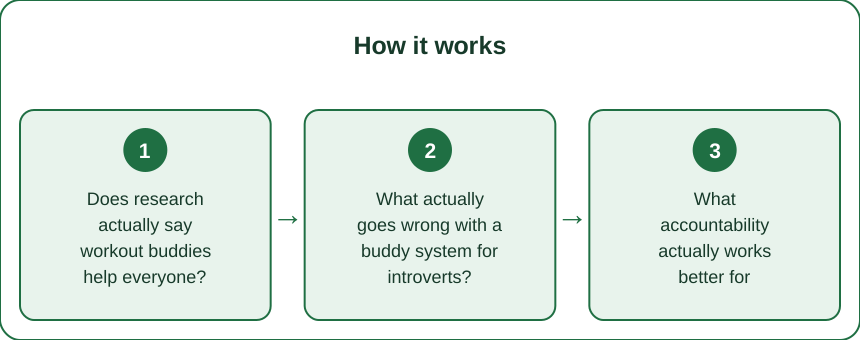
Does research actually say workout buddies help everyone?
Most of the accountability-partner research doesn’t separate results by personality type — it just shows that social accountability works on average. Averages hide the split: for people who find social interaction draining rather than energizing, a workout buddy can add friction instead of removing it.
What actually goes wrong with a buddy system for introverts?
The issue usually isn’t the workout — it’s the coordination and performance layer around it: scheduling around someone else, small talk between sets, feeling watched during hard reps. For an introvert already managing limited social battery, that layer can make a workout feel like a social obligation rather than personal time.

What accountability actually works better for introverts?
Structural accountability — a visible streak counter, a workout calendar, a pre-committed program — tends to outperform social accountability for this group, because it doesn’t cost social energy to maintain. Apps with private tracking (no social feed, no partner check-ins) consistently show up as a preferred format in introvert-focused fitness surveys.
Is there a middle ground between fully solo and a full buddy system?
Yes — low-contact accountability works for a lot of introverts: a friend who wants a one-line text after each workout, no conversation required. This keeps a light social thread without the coordination or performance cost of training side-by-side.
FAQ: Workout Accountability for Introverts, Answered
Does this mean introverts should never train with a partner?
Not at all — some introverts genuinely enjoy training with one specific, comfortable person. The key distinction is choosing a partner deliberately, not defaulting to one because advice columns say you need one.
What if solo workouts start feeling isolating?
That’s a signal to add social contact in a lower-cost form — a group class attended solo, or a workout done in a shared but not interactive space like a gym floor — rather than jumping straight to a training partner.
Are streaks and tracking apps actually effective long-term?
For many people, yes — visible progress and streak mechanics tap into consistency motivation without requiring social energy, which is exactly the gap they’re filling for introverted exercisers.
TL;DR:
- Workout buddy advice is built on averages that don’t account for personality type
- Coordination and performance pressure can cost introverts more energy than the workout itself
- Structural accountability (tracking, streaks, calendars) tends to work better than social accountability
- Low-contact check-ins are a middle ground if full solo training starts feeling isolating
The ‘right’ accountability system is the one that doesn’t drain you before you even start.
Keep Reading
This article is for general informational and styling purposes only. Fit, sizing, and product availability may vary.