Should You Actually Tell Your Trainer or Coach That You're an Introvert?
Quick Answer: Telling a trainer you’re an introvert, or better yet describing specific preferences like fewer mid-set check-ins, is worth doing — most professional trainers adjust well once they know, and it usually improves the working relationship rather than creating friction.
It feels like an odd thing to bring up between reps and sets. But a trainer who doesn’t know can default to constant encouragement and chatter that drains rather than motivates — and a short conversation usually fixes that.

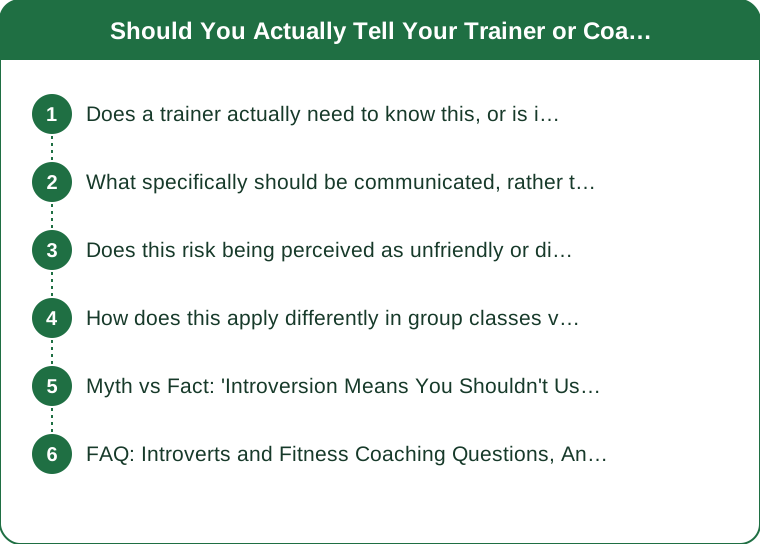
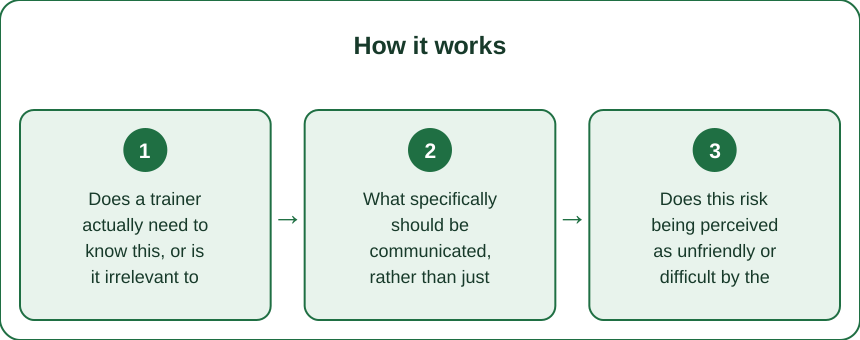
Does a trainer actually need to know this, or is it irrelevant to the workout itself?
It’s more relevant than it might seem — a trainer who doesn’t know a client prefers minimal chatter and more independent working time might default to constant conversation and check-ins meant to be encouraging, which can actually feel draining rather than motivating for an introverted client, undermining the very rapport it’s meant to build.
What specifically should be communicated, rather than just the general label?
Being specific about preferences tends to work better than the label alone — something like ‘I focus best with fewer check-ins mid-set’ or ‘I’d rather we talk before and after rather than during’ gives a trainer concrete, actionable direction, whereas ‘I’m an introvert’ alone leaves them guessing at what that actually means for how they coach.
Does this risk being perceived as unfriendly or difficult by the trainer?
Generally not, and most professional trainers respond well to direct, clear communication about working style — it’s a normal part of individualizing a training relationship, similar to communicating an injury history or a scheduling preference, and a good trainer treats it as useful information rather than a personal slight.

How does this apply differently in group classes versus one-on-one training?
In one-on-one settings, direct communication with the trainer covers most of it, since they control the pacing and interaction style directly. In group settings, the adjustment is more about personal strategy — choosing a spot in the room with less forced interaction, or arriving in a way that avoids extended pre-class small talk — since a group instructor can’t individualize the same way.
Myth vs Fact: ‘Introversion Means You Shouldn’t Use a Trainer at All’
Myth: introverts do better working out entirely alone, so hiring a trainer defeats the purpose. Fact: many introverts benefit significantly from the accountability, technique correction, and structure a trainer provides — the actual adjustment needed isn’t avoiding trainers altogether, it’s communicating a working style that reduces unnecessary social demand within those sessions, which most trainers can and will accommodate once they know.
FAQ: Introverts and Fitness Coaching Questions, Answered
Is it better to mention this preference in an initial consultation or wait until a few sessions in?
Mentioning it upfront, even briefly, tends to save both people some early friction — though it’s also completely fine to raise it after a session or two once a specific pattern (like feeling drained by mid-set chatter) becomes clear.
What if a trainer doesn’t adjust after being told?
A trainer who consistently disregards a clearly communicated preference after being told directly is a reasonable signal to consider whether that trainer-client fit is actually working, independent of their technical competence.
Does this same logic apply to communicating with a running or workout buddy, not just a paid trainer?
Yes — the same principle of being specific about preferred interaction style (quiet stretches versus chatty ones, for example) tends to improve those relationships too, for exactly the same reasons.
TL;DR:
- Communicating specific working-style preferences, not just the introvert label, gives a trainer something actionable
- Most professional trainers respond well to this and treat it as useful, not difficult, information
- One-on-one settings allow direct communication; group settings call more for personal positioning strategy
- A trainer who ignores a clearly stated preference is worth reconsidering, regardless of technical skill
It’s a small conversation that tends to make the training relationship noticeably smoother — most trainers would rather know than guess.
Keep Reading
This article is for general informational and styling purposes only. Fit, sizing, and product availability may vary.