Should Introverts Avoid Team Sports Entirely, or Is There a Way to Make Them Work?
Quick Answer: Team sports aren’t inherently wrong for introverts — the constant social demand is real, but a sport with clear roles, defined structure, and natural breaks between high-interaction moments (like doubles tennis or a defined-position team sport) tends to work far better than one requiring constant, unstructured social coordination. The right question isn’t ‘team or solo’ but ‘how much unstructured social demand does this specific sport require.’
Everyone assumes introverts should just stick to solo training. But some team sports genuinely energize introverts, while others drain them fast — the difference isn’t the team part, it’s the structure underneath it.
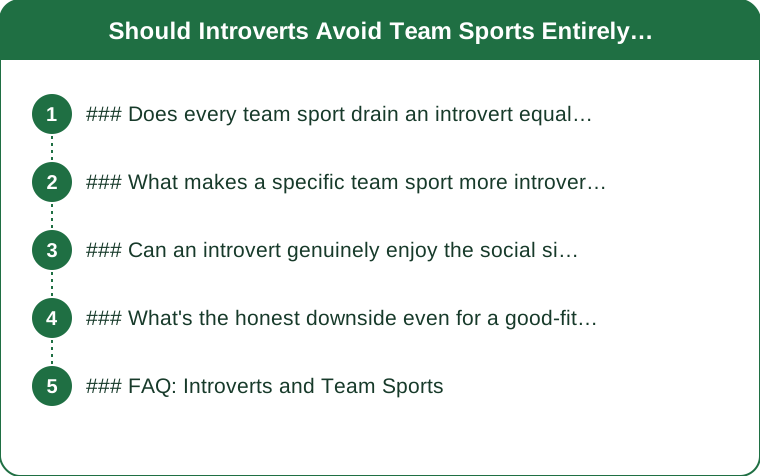
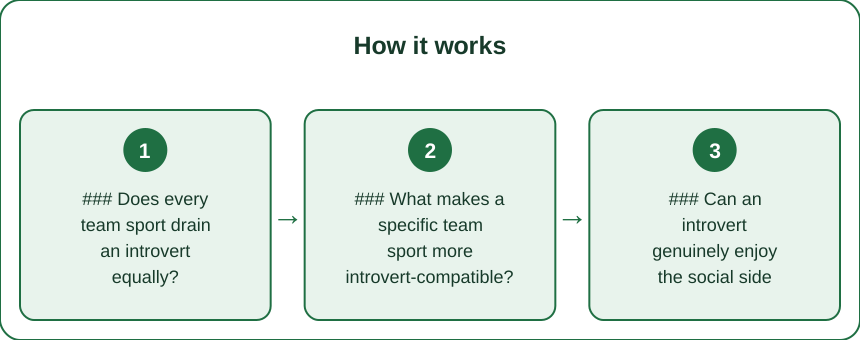
### Does every team sport drain an introvert equally?
No — sports with clearly defined individual roles and less constant verbal coordination (like a fixed position in soccer, or doubles tennis) tend to be far less draining than sports requiring continuous, fluid group communication throughout play, like basketball’s constant calling and switching. The social demand isn’t uniform across ‘team sports’ as a category, so a blanket avoidance misses real differences between options.
### What makes a specific team sport more introvert-compatible?
Structure and predictability matter more than team size. A sport with clear positions, defined turns, and natural pauses between plays (like volleyball rotations or baseball’s inning structure) gives an introvert’s social battery periodic recovery windows that a fast, continuously flowing sport doesn’t offer.
Sports with a smaller consistent group (like a doubles or small-team format) also tend to feel more manageable than large-roster sports with constantly shifting lineups and unfamiliar teammates.

### Can an introvert genuinely enjoy the social side of a team sport?
Yes, often more than expected — a shared, structured goal (winning a point, executing a play) gives social interaction a clear purpose, which many introverts find easier to engage with than open-ended socializing with no defined function. The discomfort many introverts associate with ‘team sports’ is often really discomfort with unstructured mingling, not with goal-directed collaboration itself.
This is why some introverts who dread post-game team dinners still genuinely enjoy the actual gameplay itself — the two experiences draw on very different social demands.
### What’s the honest downside even for a good-fit team sport?
Recovery time after games or practices is still real and worth planning for, even for a well-matched sport — team environments are more socially demanding than solo training regardless of structure, and pretending otherwise sets up burnout. Scheduling deliberate solo recovery time after team sessions, rather than stacking more social plans right after, protects the parts of the sport that are genuinely working.
This isn’t a sign the sport is wrong for you — it’s just an honest accounting of the actual cost, which every introvert doing team sports benefits from planning around rather than ignoring.
### FAQ: Introverts and Team Sports
Should I try a team sport if I’ve always assumed I’m not the type?
It’s worth testing a structured, smaller-format option (doubles tennis, a defined-position sport) before ruling out team sports entirely based on a general assumption.
Is it okay to skip the social extras (team dinners, group chats) and still fully participate in the sport?
Yes — participating in the actual gameplay while opting out of unstructured social extras is a reasonable and common boundary, not a sign of not belonging on the team.
How do I know if a team sport is draining me in an unsustainable way versus just normally tiring?
If you consistently need multiple days to recover your social battery after sessions and dread the next one specifically because of the social load, that’s worth reconsidering versus a sport with more built-in structure.
TL;DR:
- Not all team sports demand the same level of unstructured social interaction
- Sports with clear positions, turns, and natural pauses are more introvert-compatible than continuously flowing ones
- Structured, goal-directed collaboration often feels easier than open-ended socializing
- Plan real recovery time after team sessions even for a well-matched sport
The question was never really ‘team sport or not’ — it’s how much unstructured social demand a specific sport carries, and that’s worth checking sport by sport instead of ruling out the whole category.
Keep Reading
This article is for general informational and styling purposes only. Fit, sizing, and product availability may vary.