How to Stay Motivated When You Always Work Out Alone
Quick Answer: Solo exercisers sustain motivation best through self-generated structure — a fixed schedule, visible progress tracking, and pre-decided workouts — since they can’t rely on external accountability like a class time slot or a workout partner’s expectations to show up for them.
The gym-buddy accountability trick genuinely works — for people who have a gym buddy. For everyone else, motivation has to come from a different design.

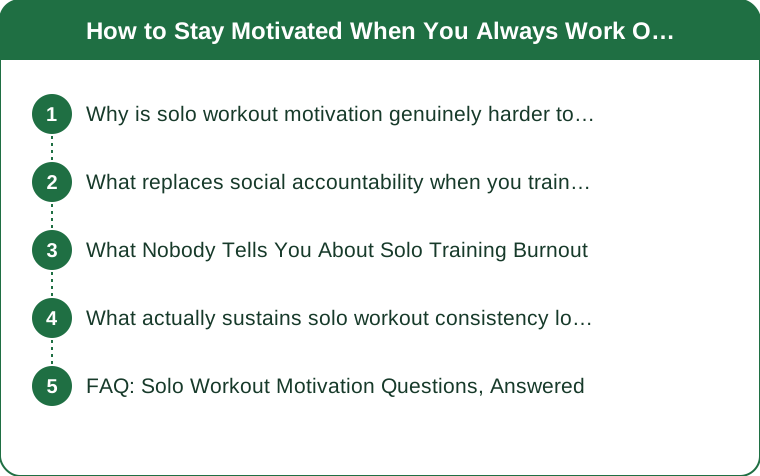
Why is solo workout motivation genuinely harder to sustain than group motivation?
Group and partnered exercise borrows motivation from external social accountability — showing up because someone expects you, or because a scheduled class has already started. Solo training has none of that built-in scaffolding.
This isn’t a personal-willpower failure; it’s a structural gap, which means the fix is structural too, not just ‘trying harder.‘
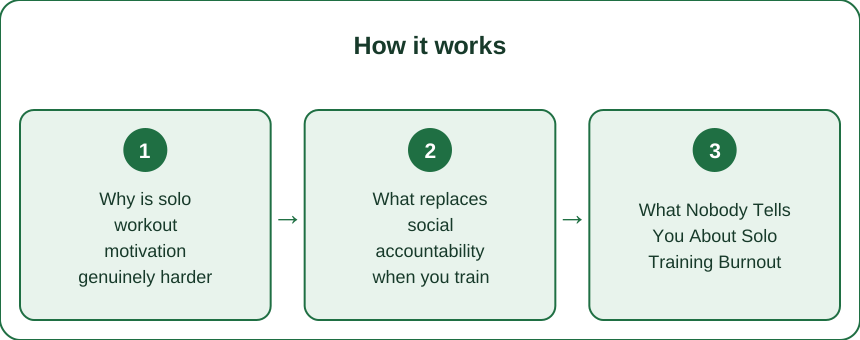
What replaces social accountability when you train alone?
Self-accountability systems — a visible streak tracker, a fixed calendar block treated as non-negotiable, or a simple checklist — recreate some of the same psychological pressure that a workout partner would otherwise provide.
The specific tool matters less than the fact that it’s visible and checked regularly; an invisible mental commitment to ‘work out more’ rarely survives a busy week.

What Nobody Tells You About Solo Training Burnout
Here’s the part that surprises people: solo exercisers often overtrain in motivated bursts and then disappear for weeks, precisely because there’s no external pacing (a class schedule, a partner’s rest days) keeping intensity in check.
Without that external calibration, motivation becomes all-or-nothing — which is often a bigger threat to long-term consistency than simply lacking motivation to start.
What actually sustains solo workout consistency long-term?
- Pre-deciding the workout the night before, removing the in-the-moment decision fatigue that kills motivation
- Fixed time blocks treated like unmovable appointments rather than ‘whenever I feel like it’
- Visible progress tracking (a simple log, not necessarily an app) since solo training has no external witness to your improvement otherwise
- Deliberately building in lighter days to prevent the burst-then-disappear pattern
FAQ: Solo Workout Motivation Questions, Answered
Does working out alone actually produce worse results than group training?
No — physiologically, results depend on programming and consistency, not on whether others are present; the challenge is purely on the motivation-sustaining side.
Should introverts eventually try group fitness to stay motivated?
Not necessarily — many introverts sustain solo training just fine with the right self-structure; group settings help some people but drain others, so it’s a personal fit question, not a requirement.
What’s the fastest way to rebuild motivation after falling off a solo routine?
Restarting with a smaller, easier commitment than before (even 10 minutes) tends to work better than trying to immediately resume the previous intensity, which often triggers another drop-off.
TL;DR:
- Solo training lacks the built-in social accountability that sustains group exercise motivation
- Self-accountability systems (visible tracking, fixed schedules) fill that structural gap
- Motivated bursts followed by disappearing weeks is a common, preventable solo-training pattern
- Pre-deciding workouts removes the decision fatigue that often kills motivation in the moment
Motivation for solo training isn’t weaker — it just needs a system doing the job a workout partner would otherwise do.
Keep Reading
This article is for general informational and styling purposes only. Fit, sizing, and product availability may vary.