What Happens When Your Quiet Training Window Disappears?
Quick Answer: When your quiet slot disappears, treat it as a logistics problem, not a motivation problem. The specific thing that made training work was low social load, and that is a genuine requirement rather than a preference. The fix is finding a new low-load window — often earlier, later, or a different day — rather than trying to tolerate the crowded one through willpower.
For six months, Tuesday at ten was empty. You could train without speaking to anyone.
Now it is full, and you have skipped four sessions in a row and decided you have lost discipline.
You have not. Something specific changed, and it is worth naming precisely.

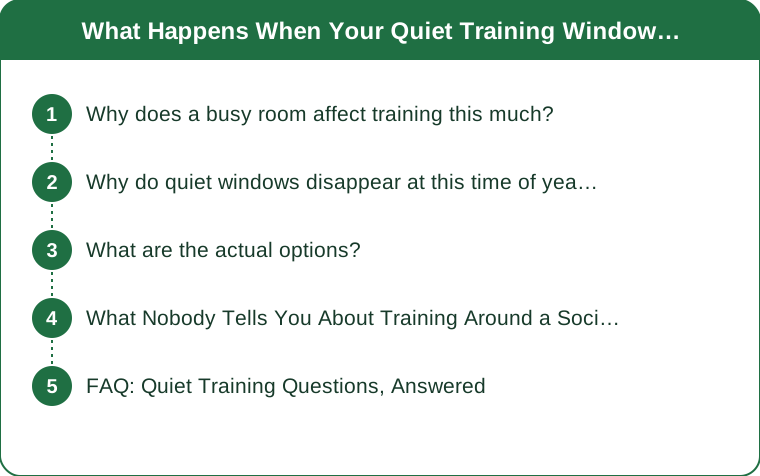
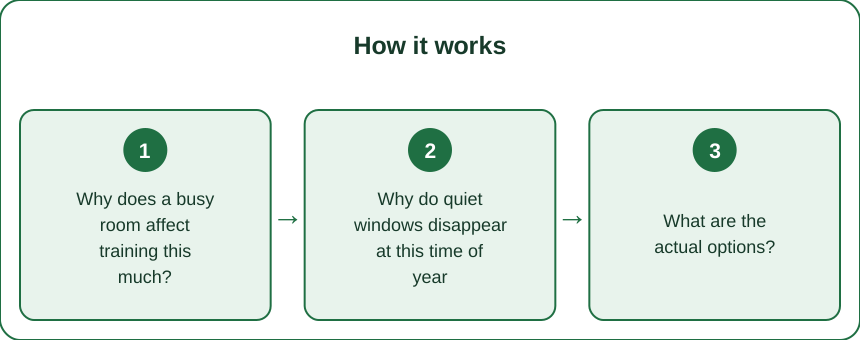
Why does a busy room affect training this much?
Because the social load is a real cost, and it comes out of the same budget as the training.
Being around people requires energy for introverts in a way it does not for extroverts. This is not a preference or an anxiety — it is a well-described difference in how stimulating environments are experienced. A crowded gym involves noise, unpredictable interaction, being observed, and constant low-level navigation of other people.
That cost is paid before the workout starts. By the time you have found a space, waited for equipment, and had two conversations you did not plan, some of what you brought is already spent. The session then feels harder for reasons that have nothing to do with fitness.
Unpredictability is a large part of it. A quiet gym is predictable. A busy one means you cannot plan your session, equipment might be occupied, and someone might talk to you at any point. The unpredictability is more draining than the number of people.
Recovery from the session takes longer. Many introverts find a socially demanding workout requires recovery time afterwards that a solitary one does not, which means a busy session costs more than just the hour.
And the response is usually avoidance rather than complaint. Instead of noticing the room got harder, most people notice they stopped going and attribute it to themselves.
Why do quiet windows disappear at this time of year specifically?
Several patterns converge in late summer and autumn, which is why this tends to happen to everyone at once.
The academic year restarts. Students return, school runs resume, and parents’ schedules shift. Mid-morning and late-afternoon slots that were quiet through summer refill.
Outdoor training moves indoors. As daylight shrinks and weather turns, runners, cyclists and outdoor exercisers move into gyms, adding population that was not there in July.
Darkness shrinks the usable outdoor window. If your quiet time was an evening run, the available daylight collapses through September and October, and everyone competes for the same shrinking slot.
Autumn is a common restart point for new memberships. The post-summer motivation wave brings a genuine influx that typically thins out again by late November.
Which means two things. First, this is predictable — you can anticipate it rather than being surprised annually. Second, part of it is temporary, and the room will thin out again, so an interim solution for six to eight weeks may be all you need.

What are the actual options?
Can you shift the time rather than the place?
Usually the highest-yield move. Off-peak windows still exist, they have just moved — commonly very early morning, mid-afternoon, or late evening. Weekend early mornings are frequently the quietest hours of the entire week and are widely underused. Go once at a candidate time purely to observe, without training, and you will know within ten minutes.
Should you train at home instead?
For many introverts this is the answer rather than a compromise. A modest home setup — a few dumbbells, bands, a mat — covers a great deal of training with zero social load. The honest trade is that home training requires more self-direction, so it works best with a written programme rather than deciding in the moment.
Can you change what you do rather than when?
Some training is far more crowd-tolerant than other training. Machine-based or single-station work needs less equipment negotiation than a session moving between five pieces of kit. Choosing a programme that occupies one corner with minimal movement makes a busy room substantially more manageable.
Is outdoor training a real alternative in autumn?
Yes, with a lighting and clothing investment made now rather than in November. A head torch, reflective layers and a route you know in the dark expand the usable window considerably. Many people find dark early mornings are the quietest and most pleasant training of the year — but only if the kit is sorted in advance.
Should you just tolerate the crowded room?
Sometimes, but not as a default. If the crowding is genuinely temporary — an autumn influx that thins by December — riding it out with reduced expectations is reasonable. If it is structural, waiting for it to resolve means several months of missed training.
Is it worth changing gyms?
Worth considering rather than dismissing. Facilities vary enormously in peak patterns, layout and general atmosphere, and a quieter or better-laid-out gym can solve permanently what schedule adjustments solve partially. Visit at the time you would actually train, not at a convenient time.
What if none of the options fit your schedule?
Then reduce the number of gym sessions and supplement at home. Two gym sessions at a genuinely quiet time plus two home sessions is far more sustainable than four crowded sessions you skip half of.
What Nobody Tells You About Training Around a Social Battery
Naming the constraint is most of the solution. People who identify low social load as an actual requirement solve this in a week. People who frame it as a discipline problem spend months failing to force themselves into a room that costs them too much.
Consistency comes from removing friction, not adding motivation. Every skipped session in this situation is friction, and friction is an engineering problem with engineering solutions — different time, different place, different format.
Headphones are a legitimate tool, not a crutch. They visibly signal unavailability and reduce ambient noise, and for many people they convert an intolerable room into a workable one.
The changing room is often harder than the gym floor. It is more enclosed, more social and less structured. Arriving changed and leaving quickly eliminates the single most draining part of the visit for a lot of people.
Your requirement will change through the year, and that is fine. The schedule that works in October may not work in June. Treating the schedule as something to revisit each season, rather than something you should be able to hold indefinitely, prevents the annual cycle of feeling like you failed.
FAQ: Quiet Training Questions, Answered
Am I just avoiding discomfort?
Avoidance and accommodation are different. Avoiding all social situations is worth examining; choosing training conditions that let you train consistently is straightforward optimisation.
When are gyms actually quietest?
Very early mornings on weekdays, mid to late morning outside of term-time patterns, and early weekend mornings. Peak is generally weekday evenings, particularly Monday through Wednesday.
Will the autumn crowd go away?
The seasonal influx typically thins considerably by late November or December. Whether the underlying pattern returns to summer levels depends on your facility.
Is a home gym worth it for this reason alone?
For many introverts, yes. The value is in the sessions you complete rather than in the equipment, and even a small setup removes the largest barrier entirely.
How do I deal with someone who talks to me every session?
Headphones in, brief and friendly reply, return to the set. Most people read the signal without any awkwardness, and it is a normal gym convention rather than a snub.
Should I train with a friend to stay accountable?
Only if their company genuinely energises you. For many introverts, a training partner adds social load to the one part of the day that was free of it, and accountability is better sourced from a written plan or a log.
TL;DR:
- A crowded room is a real cost, not a discipline failure — social load comes out of the same budget as the session.
- Quiet windows disappear predictably in autumn: term restarts, outdoor training moves inside, daylight shrinks.
- Shift the time first — very early mornings and weekend mornings are the most underused quiet hours.
- Home training, single-station programmes and arriving pre-changed all remove friction cheaply.
- Part of the autumn crowd is temporary. An interim plan for six to eight weeks may be all you need.
Sort your dark-morning kit now, and the quietest training of the year opens up instead of closing down.
Keep Reading
This article is for general informational and styling purposes only. Fit, sizing, and product availability may vary.